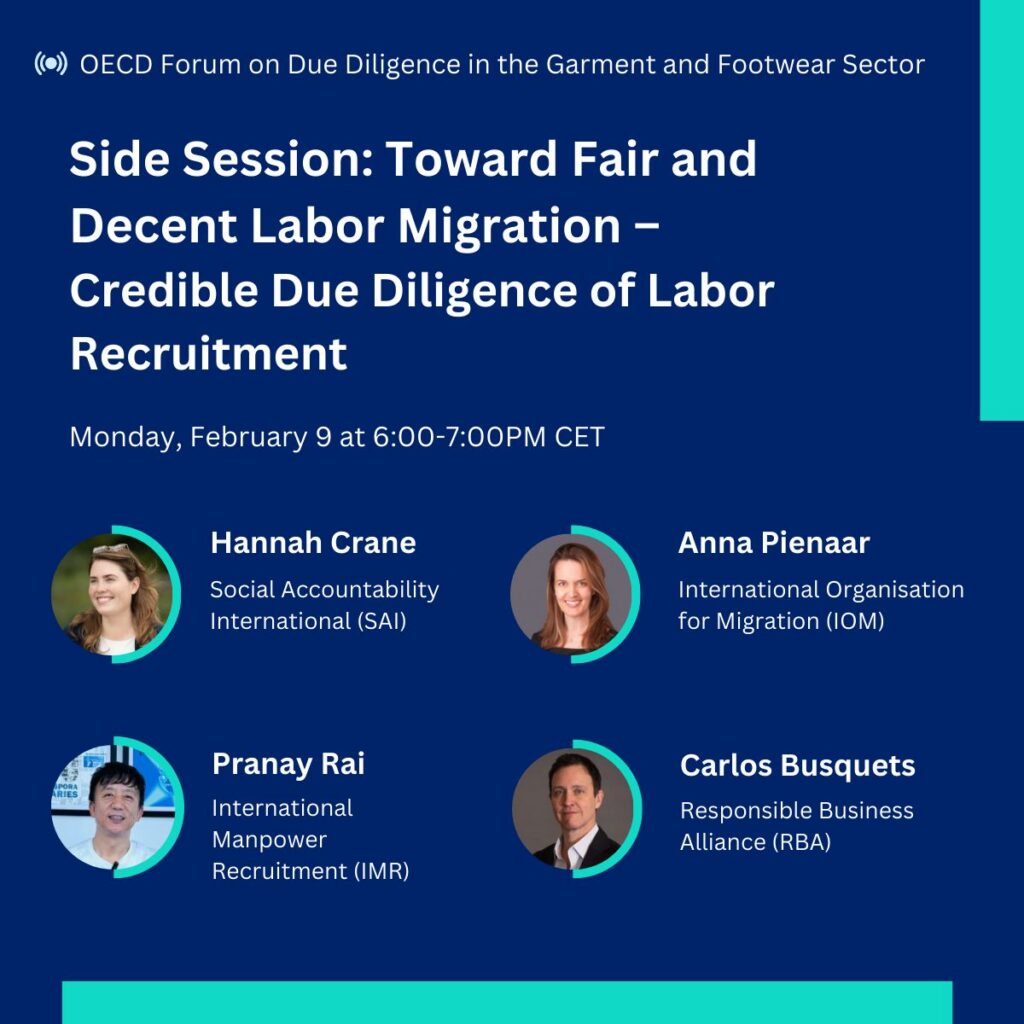
Global apparel and footwear supply chains rely heavily on migrant workers, yet the systems that manage their movement across borders remain some of the least transparent and most vulnerable to abuse. In a virtual side session to the 2026 OECD Forum on Due Diligence in the Garment and Footwear Sectors, hosted by Social Accountability International and moderated by Hannah Crane, speakers from the International Organization for Migration (IOM), the Responsible Business Alliance (RBA), and International Manpower Recruitment (IMR) discussed ethical recruitment for migrant workers and the challenges of ensuring fair, decent labor migration. They also explored how companies can strengthen due diligence in labor recruitment. View the session recording.
Across two panels, the speakers highlighted the risks migrant workers face and shared practical steps companies can take to encourage and participate in ethical recruitment. Their insights painted a clear picture of what it will take to advance ethical recruitment on a scale.
Panel One: Understanding Recruitment, IRIS, and the Challenges to Ethical Recruitment
Anna Pienaar (IOM) and Carlos Busquets (RBA) opened the panel introducing how their organizations are working to create safer recruitment environments for migrant workers. They highlighted several tools that support this work, including the International Recruitment Integrity System (IRIS). IRIS is a global framework designed to promote ethical recruitment and strengthen due diligence. It provides clear principles, practical guidance, and a certification structure that helps build trust and accountability across recruitment systems.
Speakers discussed the major challenges that continue to hinder ethical recruitment, even as awareness grows. These include:
- Opaque recruitment ecosystems
Recruitment often involves multiple intermediaries operating with limited oversight. This fragmentation makes it difficult for employers to trace who is recruiting their workers, under what conditions, and at what cost. Without transparency, companies struggle to identify risks or verify whether workers were recruited ethically.
- Misaligned regulations
Recruitment laws vary widely between sending and receiving countries. Some have weak enforcement or outdated rules, while others regulate agencies strictly. This lack of alignment creates loopholes that enable unethical practices and makes it hard for companies to rely solely on government systems.
- Market failures
Anna emphasized that workers paying recruitment fees is not a coincidence, it is how the system has been structured. Costs are pushed onto workers, often leading to debt bondage, a type of forced labor. Certification alone has not solved this, as supply chains remain opaque, brands are not aligned, and many employers are still unwilling to absorb recruitment costs.
Carlos (RBA) added that scaling ethical recruitment remains difficult because there is no strong market demand for it. Some companies even saw business decline when they adopted ethical recruitment practices. In response, RBA launched the Responsible Labor Initiative, which aims to create more visibility, learning opportunities, and value for brands and recruitment agencies.
IRIS: International Recruitment Integrity System
IRIS is a social compliance scheme designed to promote fairness for workers, employers, and recruiters for cross-border labor migration. It sets principles that aim to bring transparency to a system that is often opaque and difficult to navigate and provides a certification program that brings recognition to credible, ethical recruiters. IRIS also works to build the capabilities of employers and recruiters to embed ethical recruitment practices in their operations. IRIS promotes the Employer Pays Principle, which ensures that recruitment fees are never borne by workers, a crucial step for preventing debt bondage among migrant workers.
Overall, IRIS supports the development of a global recruitment system that protects migrant workers, reduces risks, and encourages ethical and responsible hiring practices.
Panel Two: IMR’s Journey Into Ethical Recruitment
Pranay Rai (IMR) opened the second panel by sharing IMR’s path toward ethical recruitment. IMR is a labor recruiter in Nepal that has incorporated ethical recruitment practices and achieved IRIS certification, which it has held since 2016.
He explained that IMR’s journey to ethical recruiting was motivated by competition and opportunity; ethical recruitment was gaining global attention, and agencies that adopted it were becoming preferred partners. IMR didn’t want to be left behind. Nepal sends a large number of migrant workers abroad, and IMR saw a chance to position itself as a trusted, compliant, and future-ready recruiter in a market where ethical recruitment was still rare. This early commitment made IMR stand out.
With support from the IRIS program, IMR began its transition into ethical recruitment. The global recognition of IRIS helped IMR build credibility with employers in new sectors and countries. Because IRIS aligns with international standards, it was a strong fit for IMR’s plan to move away from a hybrid model and adopt a recruitment approach that met global expectations.
Challenges in Implementation
Pranay also spoke honestly about the challenges IMR faced along the way.
- Business sustainability
Ethical recruitment demand is still limited and unpredictable. This makes it difficult for agencies to rely on it as a stable source of revenue. Without consistent demand, ethical recruiters face financial risk. - Translating IRIS standards into the Nepal context
Implementing IRIS is not a simple exercise. It requires understanding the intent behind the standards, adapting them to local realities, and constantly innovating. In Nepal, this was especially challenging because many migrants rely on middlemen and workers fear losing job opportunities if they question the process. IMR invests heavily in local engagement with workers and communities to overcome initial reluctance and build trust.
What works
Across both panels, speakers emphasized the strategies that are needed to overcome these challenges.
- Partnering with governments
Working closely with governments, especially in ways that align with their agendas and environment and can drive long term structural change. Relying on the private sector alone is not enough to scale ethical recruitment. - Engaging both sides of migration
Ethical recruitment requires alignment between sending and receiving countries. Because migration is a cross-border system, focusing only on one side does not address the root issues. Long term engagement in both the sending and receiving countries is essential for creating responsible recruitment that protects workers and reduces risk for employers. - Creating alignment between initiatives
Multiple actors—the government, industry groups, NGOs, and companies—run programs with the purpose of encouraging ethical recruitment. Aligning these initiatives reduces duplication and ensures that programs build on what already exists. Alignment on initiatives also helps employers and recruiters better understand expectations. This strengthens impacts and moves us steps closer to ethical recruitment.
Conclusion
The OECD Forum made it clear that advancing ethical recruitment is both urgent and achievable. The challenges are real, but frameworks like IRIS and growing industry collaboration offer a strong foundation for change. When these tools are applied consistently, they help shift recruitment away from practices that expose workers to debt and exploitation and toward systems that prioritize transparency and fairness.
Progress depends on collective action. Ethical recruitment cannot be achieved by one actor working in isolation; it requires brands, employers, recruiters, and governments to move in the same direction. When these efforts align, the recruitment industry can evolve into one that truly protects workers and supports fair, decent labor migration.
